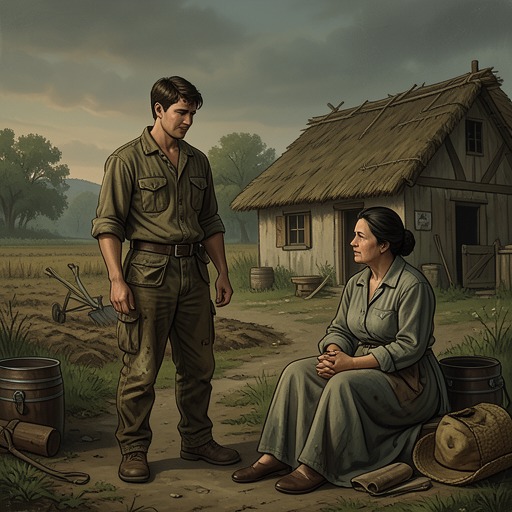
Szymek’s fight with Dominikowa
The PeasantsSzymek’s fight with Dominikowa begins as a demand for money to marry Nastusia Gołębianka and becomes a violent struggle over who has authority in the household. Jagna arrives in the middle of the dispute; within moments, Szymek and his mother are fighting, Dominikowa is badly burned, and she declares that he will receive neither land nor food from her.
Background and Immediate Cause
The confrontation is already underway when Jagna reaches her mother’s home. After breakfast, Szymek has been sitting by the window, weighing his words before asking Dominikowa for money. He needs it to arrange the banns: the priest has told him to come before vespers for the prayers. When Dominikowa asks whom he intends to marry, he names Nastusia Gołębianka. His request is not merely for the cost of a ceremony. He also says that five roubles are needed for the betrothal celebration, and his mother’s refusal blocks the practical first step toward the marriage he has chosen.
Dominikowa mocks the preparations and refuses to let him wed. Szymek answers that he will manage without her permission, then insists that she give him the money. Their disagreement makes plain that his wish to marry has run up against her control of the household’s resources. When she will not hand over the cash, he announces that he will find it himself, turning an argument about consent and money into a physical contest over the family chest.
The Fight and the Injury
Szymek tears open the chest and throws the clothes onto the floor in search of the money. Dominikowa attacks him, clawing at his curls, striking his head and face, and kicking him; when he shakes her off, she falls across the room, springs up, and comes at him with the poker. Szymek tries to defend himself and take the weapon from her rather than continue fighting, but she repeatedly lunges at him. The struggle turns the household argument into a public, bodily brawl: Jagna rushes in to separate them, while people hurry from nearby homes and gather in the room and hallway.
The intervention fails. Locked together and crashing against the walls and furniture, mother and son keep fighting until Szymek punches Dominikowa between the eyes, seizes her by the sides, and throws her across the room. She lands heavily on the hot baking plate among the boiling pans; the stove collapses around her. Pulled from the wreckage with severe burns and smouldering skirts, Dominikowa still struggles to reach Szymek, and the others have to put out the fire and hold her down so they can cover her face with damp rags.
Aftermath and Expulsion
Even after Dominikowa has been pulled from the wreckage, her burns do not end the struggle. Ignoring the pain and the smouldering of her skirts, she continues trying to get at Szymek and roars at him to leave. The women have to put out the fire and hold her down long enough to cover her face with damp rags. Szymek, beaten and bloody, can only stare at her, shaking and unable to speak; the violence has left him as stunned as it has left her injured.
When the room has barely quieted, Dominikowa breaks free again. She tears Szymek’s clothes from the pole beyond the range and throws them through the window into the orchard, turning the quarrel into an expulsion from the household. With what strength remains, she insists that nothing there belongs to him: she will give him neither land nor food, even if he starves. The threat makes the resources at the heart of the dispute explicit—marriage money, a place in the household, and a share of property are all under her control. Exhausted and in acute pain, she finally collapses in agonized moaning and is carried to bed, while the crowd that has gathered fills the room and hallway and peers in through the window.
Narrative Significance
The scene makes the household’s economic authority visible through its objects and spaces: the chest Szymek tears open, the clothes Dominikowa casts into the orchard, and the stove that collapses as their struggle reaches its worst point. A dispute over the means to marry thus becomes a rupture in their shared home, witnessed by neighbors who crowd the room, hallway, and window. Dominikowa’s final refusal of land and food gives that break a material force beyond the immediate fight: Szymek is not only driven away but threatened with exclusion from the resources on which his place in the family depends.